THE
COMMISSION
FOR RELIEF IN BELGIUM
CHAPTER III, continued
3. The Third Year. November 1916-October 1917
The two documents which follow describe the situation which confronted the Commission at the commencement of its third year. Hoover's detailed report on conditions in Belgium showed the extent and effect of the decrease in the production of native products and demonstrated the need of increased imports. The British Government's prompt approval of Hoover's program was the auspicious beginning of what proved to be the most difficult year of the Commission's life.
.
Letters,
HOOVER TO VILLALOBAR AND TO WHITLOCK, stating the critical situation facing Belgium in winter of 1916-1917
BRUSSELS, 15 September 1916
His Excellency Marquis de Villalobar,
Spanish Minister, Brussels
His Excellency Brand Whitlock,
American Minister, Brussels
MY DEAR MARQUIS:
DEAR MR. WHITLOCK:
As the result of a general inquiry by the C.R.B. representatives as to the native food outlook, we are convinced:
a) The potato crop which last year proved insufficient for the population will next year be much worse, as the crop is 30 per cent below that of last year.
b) The breadstuff crops are fully 20 per cent under last year.
c) It is now proved that Belgian cattle which normally lived largely upon cereal fodders cannot be fattened on green feed. The cattle have therefore, owing to absence of fodder imports, failed to take on consequential weight during the summer. The meat supply will be much less than heretofore, and as there is no systematic distribution except through the soup, it will in any event benefit but a small class of the better-to-do.
d) The lack of any general system of distribution allows the indigenous fats to fall in the main into the hands of the well-to-do.
e) The industrial classes already show greatly decreased vitality, increased tuberculosis, and other bad signs.
In consequence of all this, the imports of food must during the winter rise to much larger quantities than anything we have hitherto contemplated, and this in the face of the highest prices the world has ever known.
Yours very truly
(Signed) HERBERT HOOVER
Chairman
.
Letter and memorandum,
HOOVER TO PERCY, describing the situation in Belgium and the increased program desired by the C.R.B.
LONDON, 7 October 1916
Lord Eustace Percy
The Foreign Office, London
DEAR LORD EUSTACE:
Please find enclosed herewith a report on the whole Belgian situation which expresses all our desires and hopes and, as near as we can arrive at them, the reasons therefor. It has been written with a view to giving a complete picture of the whole situation to those who are not so familiar with the ravitaillement as you are yourself.
Yours faithfully
(Signed) HERBERT HOOVER
REPORT ON THE FOOD POSITION IN BELGIUM WITH RECOMMENDATIONS BY THE COMMISSION FOR RELIEF IN BELGIUM
I
The present population in Belgium is estimated (from bread issues) at 7,500,000, divided into two political areas:
The "Occupation Zone," population 5,800,000 The "Etappen," population 1,700,000
The monthly imports at present permitted to the whole area are:
|
Item |
Tons |
| Wheat | 54,000 |
| Maize | 8,000 |
| Peas and beans | 3,000 |
| Bacon and lard | 4,000 |
| Rice | 5,000 |
| Cocoa | 350 |
| Condensed milk | 500 |
The whole of the native breadstuffs are in control of the Relief Organization and are combined with the native wheat, and a rigid bread ration is issued to the entire population. The other imports are issued upon a ration (carte de ménage) to a more limited number of people who are presumed unable to secure native supplies or in any event only partial supply. In addition the Relief Organization supplements the diet of more destitute members of the carte de ménage class by public feeding through soup for adults, by canteens for infant children, and by serving a meal each day in the schools. Approximately 6,000,000 people have a carte de ménage and 2,820,000 receive supplementary help through public kitchens.
II
In the consideration of a revised import program for the coming year, three outstanding new factors must be given weight:
a) As shown by Dr. Lucas' investigation, the industrial and minor commercial adults and the children over five years of age have been steadily underfed during the past year, and while their vitality has not been lowered to the breaking point, they cannot face another year on such a margin.
b) The new potato crop is 30 per cent to 40 per cent short of last year. The available local breadstuff harvest in the Occupation Zone is diminished by about 25 per cent, although this is compensated for by the larger German guarantees in the Etappen. The local meat supplies are again most seriously reduced, and the local fat supplies are also much diminished.
c) The considerable filtration of Dutch fish, cheese, etc., has almost ceased by virtue of the German prohibitions.
III
The coming year's outlook for native food supplies may be roughly summarized as follows:
Potatoes.---Owing to the shortage of the potato crop in the Occupation Zone it seems unlikely that there will be more than 350 grams per them per capita available for general distribution. The harvest in the Etappen is larger than this, and the German authorities have undertaken to guarantee 400 grams per them to the population, the surplus going over to Northern France.
Breadstuffs.---The cereal crop in the Occupation Zone last year, after deducting seed and the amounts allowed to producers for their own support (about 72,000 tons), gave an actual net available tonnage to the Relief Organization of approximately 230,000 tons. The net surplus from this year's harvest is estimated at 170,000 tons or, as the distribution is at the rate of 1/15 per month, equal to about 11,000 tons per month.
The harvest in the Etappen is probably 60,000 tons, and the Germans are guaranteeing approximately 12,400 tons per month, or a total of 148,000 tons, part of which must come from Northern France. There are thus roughly 30,000 tons of native wheat per month available on all counts.
Meat.---The following table shows the animals killed in the principal abattoirs for three periods:
ANIMALS KILLED IN THE PRINCIPAL ABATTOIRS
| From 1st Jan. to 31st July 1914 | From 1st Jan. to 31st July 1915 | From 1st to 29th Feb. 1916 | |
| Cows | 42,364 | 50,876 | 41,164 |
| Oxen | 24,955 | 15,025 | 18,447 |
| Heifers | 13,686 | 10,742 | 14,989 |
| Bullocks | 17,465 | 11,020 | 9,988 |
| Calves | 98,926 | 69,765 | 51,230 |
| Sheep | 96,500 | 25,770 | 35,876 |
| Pigs | 216, 087 | 110,792 | 64,767 |
| Horses | 6,429 | 4,066 | 2,554 |
| Goats | 2,452 | 757 | 11515 |
|
Total |
518,864 | 298,813 | 240,530 |
|
Average kilos per month |
8,083,000 | 5,003,000 | 4,000,000 |
The following table also shows the comparative killings in the two principal abattoirs for a more recent period compared to the last above:
MORE RECENT KILLINGS
| From 1st Jan. to 31st July 1916 (7 months) | From 1st Aug. 1915 to 28th Feb. 1916 (7 months) | From 1st Mar. to 31st Aug. 1916 (6 months) | |
| Brussels | |||
| Cows | 10,784 | 8,750 | 7,708 |
| Oxen | 4,694 | 6,485 | 2,680 |
| Heifers | ..... | ..... | ..... |
| Bulls | 2,107 | 2,039 | 1,182 |
| Calves | 15,152 | 12,597 | 7,748 |
| Sheep | 4,007 | 4,440 | 1,370 |
| Pigs | 14,410 | 7,650 | 4,440 |
| Horses | 1,273 | 710 | 490 |
| Goats | ..... | 170 | 310 |
|
Total |
52,427 | 42,841 | 25,928 |
| Cureghem | |||
| Cows | 11,443 | 9,963 | 7,058 |
| Oxen | 4,701 | 5,755 | 2,010 |
| Heifers | ..... | ..... | ..... |
| Bulls | 2,108 | 1,723 | 1,487 |
| Calves | 17,117 | 13,526 | 6,946 |
| Sheep | 9,168 | 13,987 | 3,932 |
| Pigs | 25,552 | 12,544 | 12,715 |
| Horses | 645 | 279 | 192 |
| Goats and lambs | ..... | ..... | ..... |
|
Total |
70,734 | 57,777 | 34,340 |
From these data and our other investigations we are convinced that the total meat killed does not now exceed 3,500 tons per month for the whole of Belgium, and on an even distribution this would be less than 17 grams per capita, per diem, but as the price of meat has risen to from Frs. 8 to 12 per kilo and there is no physical possibility of an even distribution, it simply means that the producers and well-to-do classes get the whole of this meat, less the amount which we buy at these high prices for the soup kitchens (for which we need about 800 tons per month).
Fats.---Fat supplies, outside those contained in the above meat, have now been reduced to a very low ebb. As shown above, there is a steady diminution in the number of animals; but of equal importance is the fact that Belgian animals are largely dependent upon cereal fodder, which has been for months non-existent. The meat, fat, and butter and milk producing capacity per head is therefore greatly reduced. The totals collected by the German Fat Central, which requires the total tallow from all abattoirs, average less than 50 tons per month. If we assume the outside figure of 500,000 milk cattle still left (against 1,000,000 before the war), the theoretical dairy fats available in butter and cheese are now less than 1,000 tons per month. Despite the legal price of 6 francs, the real price of butter is now from 9 to 12 francs, and in consequence this supply of fats also is available principally to the producers and the well-to-do. Some further theoretical fats may be estimated for the skimmed milk, but it reaches the industrial and urban population mainly through the Relief Organization and then to the children only.
Sugar---The sugar available at present is 4,000 tons per month. It is issued by the Sugar Central to the retail trade at a price of Frs. 1 to 2 per kilo, so that the lower social strata do not see much of it.
Other native supplies---There is no doubt an appreciable amount of vegetables and poultry products in Belgium, but these are, again, largely consumed by the producers and well-to-do. The number of producers of these products is, however, very considerable owing to the wide distribution of small holdings.
IV
That there is effective shortage of present supplies can be adduced from combining the above native supplies with the present imports:
|
Native |
Tons monthly |
| Meat | 3,500 |
| Fats | 1,000 |
| Potatoes | 759000 |
| Sugar | 4,000 |
| Wheat and rye | 30,000 |
|
Imports |
|
| Wheat | 54,000 |
| Maize | 8,000 |
| Peas and beans | 39000 |
| Bacon and lard | 4,000 |
| Rice | 5,000 |
| Cocoa | 350 |
| Condensed milk | 500 |
The following table shows:
A. The dietetic results of these totals
B. The minimum dietetic requirements of the population after giving weight to partial unemployment and reduction to "man-power"
C. The deficiency
| A | B | C | |
| (Grams per diem) | (Grams per diem) | (Grams per diem) | |
| Protein | 46 | 70 | 24 |
| Fats | 42 | 50 | 8 |
| Carbohydrates | 328 | 410 | 82 |
| Total calories | 1,737 | 2,400 | 663 |
No doubt the poultry and the sundry vegetables would add something to this total, but the amount would not be very important. If we adopt Professor Thompson's views of the proportion of these articles in the United Kingdom dietary and apply them to Belgian conditions it would amount to less than 150 calories per them per capita. This deficiency of the available food supplies, as brought out by the above figures, represents a monthly shortage in:
| Tons | |
| Protein | 5,400 |
| Fats | 1,800 |
| Carbohydrates | 18,450 |
for which deficiency some combination of bacon, lard, preserved fish, peas, beans, and wheat needs to be found.
V
While the above is an interesting proof of the deficiency in total supplies, the actual problem is far different. There is no equitable distribution of the native food supplies except the breadstuffs and, in a rough way, the potatoes. The other native supplies are absorbed in the main, as stated above, by the agricultural producers and the well-to-do population, who live more or less up to normal, consuming probably more than 3,000 calories; and therefore the workers and minor commercial classes are dependent, except for breadstuff and potatoes, mainly upon imports. The Relief Organization attempts to meet this situation by issuing cartes de ménage to a limited social range, but the pressure upon the communal committees during the past year has resulted in the increase of these cards from about 3,500,000 to about 6,000,000.
The carte de ménage class no doubt to some extent overlaps with the producers and the well-to-do, and no doubt many carte de ménage holders, especially among small landowners, do obtain some native supplies. It is impossible to follow every household every day and see that no overlap occurs. The ration secured by this carte de ménage class from present imports plus native potatoes and breadstuffs works out at the following ration over 6,000,000 people:
|
Grams per capita per diem |
|||||
| Commodity | Ration | Protein | Fats | Carbo-hydrates | Calories |
| Bread | 400 | 31.6 | 4.4 | 200 | 992 |
| Potatoes | 350 | 3.5 | 4.5 | 66.5 | 294 |
| Bacon and lard | 22 | .8 | 19.5 | ..... | 185 |
| Maize products | 27 | 1.2 | .3 | 22.4 | 98 |
| Peas and beans | 22 | 5.2 | .4 | 12.7 | 78 |
| Rice | 28 | .2 | .1 | 21.8 | 100 |
|
Total |
849 | 42.5 | 29.2 | 323.4 | 1,747 |
| Adopted minimum standard (as above) | ... | 70. | 50. | 410. | 2,400 |
| Giving a shortage of | ... | 40% | 42% | 21% | 27% |
Thus, this class, representing the great majority of the people, where no other native supplies are available, are obviously fully 25 per cent under minimum standards of feeding.
VI
We must assume that some portion of the carte de ménage holders are able to obtain some additional native food supplies, and, rather than increase the general carte de ménage distribution, our idea is to approach the problem by way of supplemental feeding to that section of the population which is the most necessitous and the least likely to secure any such native supplement. This we propose to do by increasing the bread ration to certain classes and by expanding the food supplies through the soup kitchens. If the basic ration of flour to the whole population be held as at present at 300 grams of flour (400 grams of bread), an addition of 50 grams of flour to workers would greatly alleviate pressure in this direction. This ration will imply a total wheat import during next year of about 58,000 to 59,000 tons per month.
We estimate the number of people on the communal soup kitchens at 1,700,000, the number of children fed by canteens at 120,000, and the children who will participate in the public school feeding at 1,000,000, or approximately 2,820,000 whose carte de ménage ration must be further supplemented by expanding the operation of these relief organs.
In order in this manner to bring up the food value of these classes, which are the ones most necessary to reach, to an effective amount, we propose that the soup kitchens should be supplied with the following supplementary commodities:
| Commodity | Grams per diem | Tons per month |
| Native meat | 10 | 846 |
| Imported bacon and lard | 20 | 1,686 |
| Cheese | 6 | 507 |
| Preserved fish | 10 | 846 |
| 46 | 3,885 |
Assuming the adults upon these soup kitchens receive the extra 50 grams of flour, the total ration to this section of the population would be:
| Grams per capita per diem | Protein | Fats | Carbohydrates | Calories |
| 940 | 54 | 52 | 358 | 2,145 |
This is still too low, but the large proportion of children will tend to liberate some proportion in favor of the adults.
In addition to the above we propose to import, for the children, 500 tons of condensed milk and 350 tons of cocoa.
The above provision of 10 grams of meat per capita for the soup kitchens is an absolute necessity and so far as possible will be obtained locally. It will be necessary, however, especially in the Etappen, to import some meat, and a provision should be made for the importation of at least 500 tons per month of preserved meat from abroad or fresh meat from Holland if it should become critically necessary.
Furthermore, the outbreak of skin diseases renders the importation of some soap absolutely necessary. Coffee is now wholly exhausted in Belgium and the people are using roasted cereals---which would answer if a small amount of real coffee could be mixed therein.
VII
The net result of this change on the imports is indicated by the following table:
| Metric tons per month | |||||
| Commodities | Present permitted import-ation | Additional | Total |
Cost per ton £ sterling |
Approximate cost per month £ sterling |
| Bacon and lard | 4,000 | 1,686 | 5,686 | 75 | 426,450 |
| Peas and beans | 3,000 | ..... | 3,000 | 27 | 81,000 |
| Cheese | ..... | 500 | 500 | 110 | 55,000 |
| Cocoa | 350 | ..... | 350 | 95 | 33,250 |
| Coffee | ..... | 1,100 | 1,100 | 60 | 66,000 |
| Fish, preserved | ..... | 850 | 850 | 40 | 34,000 |
| Maize | 8,000 | ..... | 8,000 | 11 | 88,000 |
| Meat | ..... | 500 | 500 | 55 | 27,500 |
| Milk, condensed | 500 | 500 | 1,000 | 50 | 50,000 |
| Rice | 5,000 | ..... | 5,000 | 17 | 85,000 |
| Soap | ..... | 1,000 | 1,000 | 31 | 31,000 |
| Wheat | 54 000 | 5 000 | 59,000 | 18 | 1,062,000 |
| Yeast materials | :: | 1,000 | 1,000 | 30 | 30,000 |
| Totals | 75,850 | 11,136 | 86,986 | 2,069,200 | |
It may be observed that the above additions do not provide all the apparent deficiencies in supplies as shown in IV but still leave a wide margin to be furnished by poultry and sundry vegetables.
VIII
Of the above total estimated cost of £2,069,200 approximately £330,000 is due to the increase in imports proposed. The cost of the whole program has been materially affected by the great rise in prices during the past five months, this rise representing roughly about £400,000. Out of the total of £2,069,200 the Commission hopes to be able to obtain about £150,000 per month from charity and commercial exchange, and therefore the need from subsidies represents about £1,900,000, or an increase of about £900,000 over the present subsidies.
.
Letter and memorandum,
PERCY TO HOOVER, recapitulating increases in C.R.B. imports authorized by the British government
FOREIGN OFFICE, LONDON
11 November 1916
DEAR MR. HOOVER:
1. With reference to Sir E. Crowe's letter to you of October 26th in regard to the increase in the Belgian ration, I now transmit to you herewith a complete revised table of all your rations in order to put the situation on a clear basis.
2. There seems to have been a slight mistake in Sir E. Crowe's letter to you of the 26th in regard to soap. You asked for one thousand tons of soap for Belgium and by a clerical error we authorised one thousand one hundred tons. In the annexed table I have corrected this error.
Yours sincerely
(Signed) EUSTACE PERCY
MEMORANDUM
RELIEF RATIONS FOR BELGIUM AND NORTHERN FRANCE
| Belgium | Metric Tons |
| Wheat | 59,000 |
| Maize | 8,000 |
| Rice | 5,000 |
| Peas and beans | 3,000 |
| Meat | 500 |
| Fish | 850 |
| Bacon and lard | 5,686 |
| Cheese | 500 |
| Condensed milk | 1,000 |
| Cocoa | 350 |
| Coffee | 1,100 |
| Yeast materials | 1,000 |
| Soap | 1,000 |
Clothing and clothing materials Medical supplies (not including rubber goods)
|
For the Commission's staff |
|
| Petrol | 20,000 liters |
| Lubricating oil | 1,000 liters |
| Mineral transmission grease | 100 kilos |
| Motor car accessories |
| Metric Tons | |
| Northern France | |
| Flour | 19,300b |
| Cerealine (maize) | 2,200 |
| Rice | 4,400 |
| Peas and beans | 1,650 |
| Meat | 1,800 |
| Fish | 500 |
| Bacon and lard | 3,200 |
| Cheese | 720 |
| Butter | 360 |
| Condensed milk | 1,650 |
| Cocoa | 350 |
| Coffee | 1,100 |
| Sugar | 1,320 |
| Soap | 1,000 |
Plus 650 liters per month for Consulate. Equivalent to 23,500 tons of wheat.
.
At the end of 1916 the position of the Commission was stronger than at any previous time. Administrative machinery inside and outside of Belgium was running smoothly; the prestige of the Commission was greater than ever; and relations with the belligerents were on a generally satisfactory basis. But this clear sky had its cloud, which with the passing months of 1916 had grown ominously larger. This cloud was the shortage of shipping. Losses from submarines and mines, the steadily increasing demands of the Allies, the growing reluctance of neutrals to permit the use of their ships in the dangerous waters of the North Sea and the Channel contributed to this condition, which reached its crisis on 1st February 1917 when the Germans began their unrestricted U-boat campaign.
Two months after the Germans embarked on this desperate policy the United States became a belligerent, necessitating the withdrawal of Americans from Belgium and the assumption of their functions by Dutch and Spanish nationals.(57) An immediate effect of the German declaration was the closing of the North Sea and the waters around the British Isles and the Atlantic coast of France to C.R.B. ships and the withdrawal of neutral ships from the service of the Commission. The struggle to secure ships enough to maintain a flow of food into the occupied regions is revealed in chapter v; here it is sufficient to note that, under these conditions, the promising program authorized in November 1916 was completely upset. During February 1917 a few cargoes reached Rotterdam;(58) in March only two oversea vessels arrived. A few more ships got through the U-boat blockade in April and May, and these were supplemented by an emergency loan of 20,000 tons of wheat from the Dutch Government. During these four months, however, the Commission was able by the most energetic action to import a total of only 116,000 tons against its minimum ration program of 107,000 tons each month.
In the midst of these larger issues the Commission's program was further jeopardized by German military seizures of Belgian food supplies, particularly of cattle. The only possible answer to this violation of guarantees was the suspension of import of those products which were being seized. As soon, however, as the German General Government in Brussels undertook to prevent further violation of its agreements, the program was restored.
.
Letter,
HOOVER TO BRITISH FOREIGN OFFICE, stating the revised program of the Commission and requesting the Government to take their share of responsibility for the necessary downward revision
LONDON, 16 April 1917
A. Parker, Esq.
Foreign Office, London
DEAR MR. PARKER:
In discussion with Lord Robert Cecil today, I informed him of what has been evident from the Inspection and Control reports for some time, viz., the increasing abstraction of cattle from Belgium, which has now reached enormous dimensions. Lord Robert considered it essential that a telegram should be dispatched which would reach the Marquis de Villalobar, and asked me to draft up the ideas which he expressed, which I do and attach same herewith.
I take this occasion to mention the whole of the revised program of the Relief Commission, in which I consider it advisable that His Majesty's Government should take the responsibility of authorization. We will give immediate orders to Rotterdam to cease the shipments of fats and meat into Belgium and it appears to us that a simplification of the entire matter, in view of the reduced quantities of cereals now proposed, can be accomplished by our undertaking to ship not more than 50,000 tons per month of cereals into Belgium, making no discrimination between the various articles of peas, beans, maize, wheat, rice, barley, or any other cereal which we can obtain. They all have approximately the same food value and with the reduced quantity which this involves there can be no further need of precise and elaborate shipments of each different commodity.
With regard to the North of France relief, we propose that it should amount to 17,000 tons of cereals per month and 5,500 tons of fats, meats, and condensed milk. In addition to the above articles we may be able to secure the shipment of up to 200 tons of cocoa to Belgium and 400 tons to the North of France, and in addition to this we would propose to retain the former permits to ship fish, but the supplies are very irregular and are not likely to be extensive. Our old permits provide for certain amounts of soap and sugar for the North of France, which former permits we would not exceed; but I do not propose that in present circumstances we will be able to approach the former imports. Altogether the above program represents between one-third and one-half reduction in the total quantities hitherto shipped by the Commission.
As I mentioned above, I think it would be advisable for the Government to take their share of the responsibility of the revision of this program to present necessities.
Yours faithfully
(Signed) HERBERT HOOVER
The draft is only an idea!(59)
.
Letter,
POLAND TO PAGE, stating restrictions placed on C.R.B. by British Government and alleged German violations of agreement on basis of which restrictions were made
LONDON, 14 May 1917
His Excellency the Hon. W. H. Page, London
MY DEAR MR. PAGE:
For your information I send you herewith some correspondence concerning the shipment of foodstuffs into Belgium. At the present time the following situation exists:
1. No bacon, lard, meat, or milk is allowed to be shipped by the Commission from overseas into Belgium, and this has not been done since April 18th.
2. We now have orders from the Foreign Office, as per copies attached, to stop all shipments of bacon, lard, meat, milk, butter, cheese, and similar animal products into Belgium and I am requested to telegraph these restrictive orders to our Rotterdam office.
Up to the present time as large an amount of these products as possible, of Dutch origin, has been forwarded into Belgium, consistent with sending the proper proportion to the North of France.
The reasons for the restriction of shipments into Belgium are based upon two conditions:
a) The violations by the Germans of their undertakings to reserve to the civil population native foods, and particularly the meat supply of the country. No doubt large quantities of meat were shipped from Belgium into Germany. You will see from the attached copy of a communication from His Excellency Señor Merry del Val that the Marquis Villalobar reports that Baron von der Lancken has given a definite undertaking that these violations will be stopped. This is the most important condition upon which were based the restrictions.
b) The consideration has been advanced that there is in Belgium sufficient meat and fats to supply the civil population without depending upon imports from the outside, and that these stocks ought to be reduced, in order that they might never be available as a source of supply to the Germans.
Whatever the theoretical position in this respect may be, the emphatic statements of desperate need of bacon and lard by the people of Belgium seems to me to make it plain that our duty is to send in to these suffering people a fair supply of bacon and lard from overseas, let us say 3,000 tons per month, and a fair proportion of what Dutch products can be obtained.
I have become convinced myself that the available stock of meat in Belgium is much less than we have supposed, and it must always be remembered that none of the agreements in regard to the original Étapes, including a population of 1,700,000 persons, protected the native food supply, the Étapes being on the same basis exactly as the territories of the North of France. For these reasons I am taking the liberty of withholding action in regard to notifying Belgium of the Foreign Office order until after you have had an opportunity of presenting the case to Lord Robert Cecil this afternoon.
Yours faithfully
(Signed) W. B. POLAND
Director for Europe
.
Letter,
AMBASSADOR MERRY DEL VAL TO POLAND, announcing satisfactory steps taken by the German Government to prevent export of Belgian cattle
LONDON, 10 May 1917
W. B. Poland, Esq.
Director, The Commission for Relief in Belgium
SIR:
EXPORTATION OF CATTLE FROM BELGIUM
With reference to our former correspondence on this subject and in the last instance to my letter of May 2d, I have the pleasure to inform you that according to a telegram received through Madrid from the Spanish Minister in Brussels the measures taken by the German Government to prevent fraudulent acts and abuses by part of the invading Army in violation of guarantees appear to be efficient. Baron Lancken is reported as having given proofs in this sense and is preparing an official communication which Marquis Villalobar holds to be satisfactory.
Our Minister in Brussels lays much stress upon the extreme misery entailed upon the Belgians by the want of fats and fatty foodstuffs, and urges that their importation into Belgium may once more be allowed.
I remain,
Yours faithfully
(Signed) A. MERRY DEL VAL
.
Memorandum
of meeting between AKERS DOUGLAS of the Foreign Office, HIGGINSON of the Blockade Ministry, and POLAND of the C.R.B., slating decisions relative to imports by C.R.B. of Dutch products
LONDON, 14 May 1917
After discussion it was decided:
Sugar.---For the moment no Dutch sugar is to be shipped from Holland into Belgium under the auspices of the Relief Commission. The question of action in the future is subject to further discussion. It is also suggested that it may be desirable for the Commission to purchase Dutch sugar if possible and send into Northern France, instead of importing from overseas.
Potatoes.---It was decided that no more either food or seed potatoes should be sent from Belgium into France until such time as the full quota to Great Britain has been delivered to the British authorities, thus making it possible for Holland to export potatoes into Germany. When this point has been reached, potatoes, either food or seed, may be sent in either to Belgium or France.
Meat.---It was decided, until further notice, that no beef or mutton of Dutch origin may be sent into Belgium until such time as the full British quota has been delivered to Great Britain, whereafter, as soon as meat could be sent into Germany, shipments from Dutch sources may be resumed to Belgium.
NOTE: There are no restrictions on shipments into Belgium of Dutch produce consisting of milk, butter, cheese, rabbits, poultry, eggs, and all vegetables other than potatoes.
NOTE: Shipments to France are not in discussion, as in accordance with letter from Sir Eyre Crowe dated May 7th, it was stated that supplies to Northern France were not affected.
Milk.---It was suggested that Dutch milk might be sent in wooden carriers, provided it was sweetened milk; that it was understood by the Commission that under agreement with the British Minister at The Hague, N.O.T. supplies might be sent in under C.R.B. auspices.
It was suggested by Mr. Poland that possibly glass jars might be furnished from Belgium as carriers for Dutch milk provided tin could not be obtained.
Barbed Veal.---This is not prohibited from export, not being classified as beef above and therefore may be sent in.
.
The records of the Commission's imports during the third year of its activity ending with October 1917 show the disastrous effect of the unrestricted U-boat campaign on the relief of Belgium and Northern France. During the twelve months only 725,000 tons reached Rotterdam,(60) which was less than the total of the first year of operations and only about 50 per cent of requirements. It is interesting to note, however, that though the import tonnage for 1917 was only about 55 per cent of that for 1916 the costs, as a result of increase in freight rates and prices, were practically the same---$115,000,000.
.
4. The Fourth Year. November 1917-October 1918
In drafting its program of imports for the fourth year the Commission followed the same method as in preceding years, when American representatives were still in the occupied territories. In the execution of the program, however, new conditions prevailed. Whereas, before 1917 it was the Allied blockade, after 1917 it was the German U-boat campaign which chiefly affected the realization of the program. During the last year of the war, therefore, the Commission's negotiations respecting its import program dealt primarily with questions of shipping and purchase. The documents relating to these matters appear in the two immediately following chapters.
.
Memorandum,
POLAND TO BELGIAN, FRENCH, AND BRITISH GOVERNMENTS, on food requirements of the Commission
LONDON, 20 October 1917
I. FOOD REQUIREMENTS
A short time ago I made a trip to Holland for the purpose of holding a consultation as to the general situation of the relief, with the chief of the Comité National, the secretary of the Comité Français, the protecting ministers in Belgium, the chairmen of the Spanish-Dutch Comité de Protection, and our own very reliable representative in Belgium. I was also, somewhat to my surprise, called upon by representatives of the German Government in Belgium who had been sent out to talk over present conditions with us, from whom a good deal of valuable information was obtained.
The whole range of the relief work was thoroughly discussed with these gentlemen, attention being given to the native resources of the country, the manner in which the German undertakings were being carried out, the possibilities of increasing the importations of Holland native products, etc., and particularly to the requirements for the coming winter.
As a result of the changed conditions in Belgium and France, the decrease in native products available and changes in the overseas food situation, it is necessary to adjust the minimum monthly ration (the new table for November 1st, 1917, is attached) and based upon it, to redetermine our required monthly imports. The statement for November 1917, is shown under 9.
1. Owing to a lesser area being planted and the considerably decreased unit production resulting from lack of fertilizers, improper cultivation, etc., the native crops in Belgium and France, as in most of Europe, are steadily decreasing. The German officers maintained that last year they were only able to fulfil their guarantee of 180 grams of native flour for France and the Belgian Étapes by importing flour from Germany. I am unable to say whether this was a sincere statement. There is no doubt that some flour furnished to Northern France did come from German mills, but the wheat may have come from France. However this may be, our investigations make it seem probable that the Germans are correct in their statements that the native crop of Flanders and Northern France this year will provide the civil population with not more than 100 grams of flour milled at 90 to 97 per capita per day. This amount, effective from September 1st, the Germans have officially undertaken to supply to the Belgian and French Étapes.
This issue of 100 grams of flour per capita per day replaces the 180 grams provided last year, upon which our previous ration sheet was based. It will now be necessary to make up the deficiency to the people of these territories by the importation of extra wheat.
We are providing in our program for Northern France this year, as last, a total per capita ration, including the native product of 280 grams of flour per day. To this would be added a small extra allowance for the people of the congested industrial districts such as Lille, Roubaix, Tourcoing, Valenciennes, etc.,. and a small amount to be used as torrealine and for the making of the child biscuit ration.
In Belgium we are endeavoring to provide, as heretofore, a ration of about 250 grams per capita per day for the whole population as a basis, to which are added extra amounts for child feeding, soups for the destitute, extra rations for heavy workers, etc. The agricultural community, on about 300 grams per day, retain their own supplies. The Belgian Étape is on the same basis as Northern France.
Owing to the decrease of native bread grains in France and Belgium and the corresponding increase in exotic imports, the total amount of wheat required on this absolutely minimum basis, as appears on the attached ration sheet, is 68,000 tons per month.
2. After bread grains the next most important food item is native fats, comprised of bacon, lard, butter, tallow, margarine, cheese, etc. In France there are practically no native cattle, the milk-butter products of the few remaining animals being almost completely commandeered by the German armies. The conditions in Flanders now closely approach those in France although not quite so severe.
In Belgium, owing to the lack of fodder, animal fat products in the form of milk, butter, cheese, etc., and tallow, have greatly decreased. It is quite possible that later experience will prove that we have been using too high a figure in our estimate of native products of this kind. The local prices have gone to such figures that even were it physically possible to obtain the supplies, the local cash resources of the Comité National would be inadequate to carry out the purchases. The British Foreign Office is well informed of the strong efforts we made at their request to reduce the bacon, lard, and meat imports into Belgium and force the consumption of native stocks. The result was simply to deprive the population of these essential fats and to drive great numbers of workmen into the arms of the Germans. We have slightly increased the amount of bacon and lard to be allowed to Belgium from 4,500 to 5,000 tons per month, but this still is less than the December 1916 program of 5,670 tons. A slight reduction at the same time is made in the imports for Northern France on account of the somewhat decreased population due to deportation, etc. We are not sure that this quantity will prove adequate, but the world shortage seems so serious that with the help of the native Dutch supplies we must at least make the effort to have the people maintain themselves upon it.
3. Poor as the native crop of potatoes was last year, the prospects are that, due to lack of fertilization, proper cultivation, and decreased acreage, it will be 25 per cent poorer this year. We have, however, succeeded in getting the Germans to relieve their pernicious restrictions upon inter-regional traffic, which caused great wastage of crops last year. With careful distribution it now seems justifiable to count on 190 grams of potatoes per capita per day for Northern France and Flanders and about the same for Belgium. The Germans have guaranteed to reserve to the civil population of France and Flanders the entire native crop, which they estimate will produce 200 grams per day. The inhabitants of the regions, however, are not so optimistic.
4. In the attached ration table we show considerable amounts of food imported from Holland. This supply is uncertain. It is necessary to have permits for import from the German, the Dutch, and the British Governments. Everything that can be shipped from Holland reduces the potential German food supply, obviates a certain amount of overseas shipping, and reinforces a far too meager program; as emphasized in a footnote, if at any time the Holland importations are cut down, the overseas imports must be correspondingly increased. As little restriction as possible should be put upon Dutch imports into Belgium and France.
5. Certain imports from the United Kingdom are counted upon. These cover peas, beans, and rice, which are practically impossible to obtain in the United States and are absolutely necessary items of supply for the invaded territories. The people have suffered greatly during the last six months because of the interruption of these supplies. Were we not able to obtain them in the United Kingdom we should have to import from Burma and Saigon, thereby reducing the capacity of our limited overseas tonnage.
6. Smoked herrings are an important food item. Early in the year we made arrangements to import Norwegian herrings, but at the request of the British Government, the Fisheries Department took over this for us and have arranged to supply between 15,000 and 20,000 barrels smoked herrings per month, which should produce from 1,000 to 1,500 tons net of fish.
7. Taking into account the most generous estimate of the native resources which we believe possible, it will be seen that this minimum monthly ration provides for Belgium 2,000 calories per capita per day and for France 2,141 calories per day. The slight difference is based on the fact that, aside from wheat and potatoes, there are no longer considerable native supplies to be obtained in France, while in Belgium there is still a fairly well-to-do agricultural population, which, as is always the case with agricultural classes, may be counted on to take care of its own most pressing needs before supplying others.
8. The provisions of this November 1st ration sheet represent the irreducible minimum food which must be served out to the people of France and Belgium without interruption month by month to prevent actual starvation and the breaking down of the physical and moral standards of the people. It is founded on the assumption that considerable stocks of native products will be available within the country. If, later on, the vegetable and other local supplies are reduced or the Holland imports are curtailed, or the bean and fish supplies, for instance, from the United Kingdom become unavailable, immediate steps will have to be taken to replace these foods from overseas. It must be distinctly understood that there is no elasticity whatever in this ration; it must be supplied every month without question of failure.
9. As all the reserves in Belgium, France, and Rotterdam have been wiped out, it is essential that these be built up as rapidly as possible, so that there may be some provision against shipping and other irregularities. This monthly ration must therefore be increased by 20 per cent as shown on the attached table, to represent the imports into Rotterdam.
For the months of November, December, and January, supplies have been purchased or contracted for to an extent which justified us in being confident of ability to fill completely the food requirements from overseas of this program of imports.
10. The Governments of England and France are hereby asked, in the event at any time in the future of our inability to obtain the necessary supplies from our own organization, to guarantee monthly to the Relief, from their own resources, the full cargo required by this schedule.
PROGRAM OF MONTHLY IMPORTS INTO ROTTERDAM, IN METRIC TONS, TO PROVIDE MINIMUM RATION FOR BELGIUM AND NORTHERN FRANCE, WITH 20 PER CENT ADDITIONAL ALLOWANCE ON PRINCIPAL ITEMS FOR BUILDING UP A RESERVE (November 1917)
(Effective November 1917)
| Source | Commodity | For Belgium | For Northern France | Total | Total by sources |
| New York. | Wheat | 64,200 | 17,400 | 81,600 | |
| 1/3 C.R.B. Bacon, | |||||
| 2/3 Lard | 6,000 | 3,360 | 9,360 | ||
| Milk (condensed | |||||
| sweet) | 600 | 1,440 | 2,040 | ||
| Sugar (white) | ..... | 1,440 | 1,440 | ||
| Meat | ..... | 1,200 | 1,200 | ||
| Cocoa | 300 | 300 | 600 | ||
| Barley or rye | 750 | ..... | 750 | 96,990 | |
| Argentina | Maize | 6,600 | 2,400 | 9,060 | 9,060 |
| United Kingdom | Beans (and peas) | 4,320 | 1,200 | 5,520 | |
| Rice | 6,600 | 2,400 | 91000 | ||
| Fish (herrings S.&P.) | 850 | 500 | 1,350 | ||
| Coffee | 500 | 500 | 1,000 | ||
| Soap | 500 | 800 | 1,300 | ||
| Malt culms | 250 | ..... | 250 | 18,420 | |
| Totals | 91,470 | 32,940 | 124,470 | 124,470 |
NOTE.---Principal items above will be reduced by 17 per cent per month as soon as reserves have been built up in Belgium, France, and Rotterdam.
.
During the summer of 1917 the Allies were nearer defeat than at any time during the four years of conflict. On land there were disasters in nearly every theater of war, which though not decisive in a military sense reacted heavily on the morale of the war-weary people of the Entente countries. Actually the Allies were nearer defeat on the sea than on the land, though this was not widely realized by the general public. It was this struggle of the Allies to maintain their sea communications that affected particularly the work of the C.R.B.
The decreasing tonnage led the Allies to concentrate their shipping in the Atlantic. America thus became practically the sole food market, but 1917 was an extremely short crop year in America. The Commission thus had to compete for both tonnage and supplies with desperately worried officials of the Allied states who were hard pressed to provide military materials for their troops and food and other necessary supplies for the people. Everywhere there was a tightening of food control and a stringent regulation of shipping. Hoover, then United States Food Administrator and still active Chairman of the C.R.B., succeeded in getting some tonnage which neutral owners were holding in port. Poland, the Commission's European Director, after an arduous campaign, prevailed upon the newly organized Supreme War Council to grant, in December 1917, priority to the C.R.B in both food and ships for the supply of the civilian population of Belgium and Northern France.(61) On the basis of this decision the Supreme War Council authorized the Commission to lay down a minimum monthly program of 80,000 tons for Belgium and 30,000 tons for Northern France at a cost of $22,000,000 per month, of which about one-half was European expenditures chiefly for freights.
In spite of this decision it was some time before the Commission was able to make any headway in the realization of this program. This delay was due partly to the shipping situation and partly to differences between the American and British Governments over the financing of the European expenditures.(62) In January 1918 this financial matter was adjusted, but from that time on the Commission's program was subject to review by the Commission Internationale de Ravitaillement.(63) In May 1918 the Commission's shipping difficulties were greatly relieved by an arrangement whereby the Allied Maritime Transport Council and the United States Shipping Board each agreed to make up 50 per cent of the C.R.B.'s tonnage shortage. From July 1918 onward this arrangement worked in a highly satisfactory fashion, and for the first time since November 1916 the Commission was more nearly able to realize its program of deliveries. Though the Commission was able to deliver an average of only 60,000 tons per month during the first half of the fourth year, the second six months saw an average of 100,000 tons placed in Rotterdam.(64) The total for the year ending with October 1918 was 1,091,000 tons, costing approximately $245,000,000.
Though there was a serious shortage of clothing in the occupied territories, the need of clothing was not comparable to the need of food, and hence the Commission never undertook a program of clothing deliveries on the scale of its food program. As has been noted, however, during the first year large quantities of gift clothing were distributed; and in the second year, in addition to smaller amounts of used clothing, the Commission purchased and delivered 800,000 pairs of boots. In 1917 the people were badly shod and in rags, and there was a compelling demand for blankets. After a careful analysis of requirements made early in January 1917, the Commission took steps to procure the materials for the manufacture of clothing in the workshops of the organization in the occupied territories. The list of requirements embraced every item necessary for the manufacture of men's, women's, and children's apparel, the major item being 16,000,000 yards of woolen cloth, the total cost being estimated at $10,000,000. The difficulties of relief in 1917 prevented the realization of the clothing program during this year. During 1918, however, though it was obviously impossible to meet the full program, about 50 per cent of the huge requisition was fulfilled. With the summer of 1918 the Commission made a new appeal for used clothing both in the United States and in England, with the result that some 12,000 tons were collected and distributed during the fall of 1918 and in 1919.(65)
In addition to the obvious requirements of food and clothing the Commission was from time to time required to supply innumerable items necessary for the life of a nation. For example, it was necessary to keep the flour mills running, and the Commission therefore made important importations of machine parts, belting, and filter cloth.
.
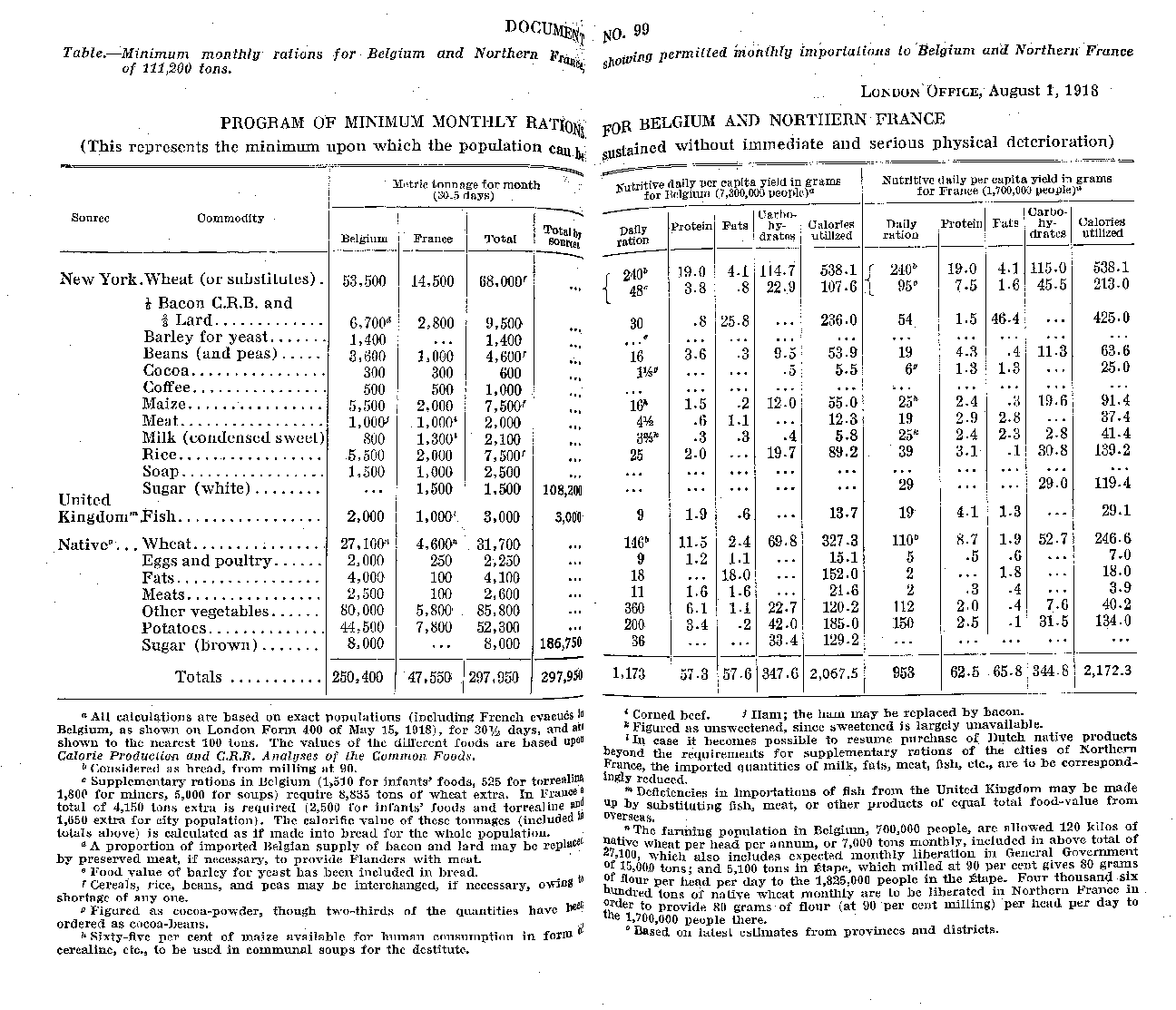
Table,
Minimum monthly rations for Belgium and Northern France showing permitted monthly importations to Belgium and Northern France of 111,200 tons.
.
5. Importations during German Evacuation.. October-November 1918
As soon as the third and last of the great German drives of the summer of 1918 was definitely checked at the second Battle of the Marne in the middle of July, the Allies launched their decisive counter-offensive which in the course of a few months pushed the last German divisions out of Northern France and Belgium. In September the line of battle, which for four years had marked the western limit of relief, began to swing toward the east. Behind the retiring German line the inhabitants were moved back and refugees from French and Belgian Flanders flocked into the large towns in the rear with disturbing effects on the highly organized system of relief distribution.
The course of military events, which appeared to be leading to a complete change in the status of all territories where relief had been delivered, raised important questions of the policy to be adopted by the Commission in the evacuated regions. One fundamental question concerned whether the French and Belgian Governments for good and sufficient political reasons wished to take over the responsibility for the relief of the evacuated territories or desired the Commission to continue its activities with such modifications as the changing situation demanded. As appears in the following documents, the French and Belgian authorities relied on the Commission to continue its service until the two Governments were better prepared to take over this work themselves.
.
Memorandum,
by W. B. POLAND, regarding conduct of ravitaillement during evacuation
PARIS, 5 October 1918
THE RAVITAILLEMENT OF THE OCCUPIED TERRITORIES OF NORTHERN FRANCE AND BELGIUM IN THE EVENT OF THEIR WHOLE OR PARTIAL EVACUATION BY THE GERMANS
The country now being taken care of by the Commission for Relief in Belgium and Northern France may be divided into three regions:
I. The military étape of Northern France directly under German military command---population 1,700,000; value of imported food to total consumption, about 85 per cent. The food for the northern sector---Lille, Roubaix, Tourcoing, Valenciennes---is brought in by lighter from Rotterdam via Ghent and Antwerp, and is distributed by water via the Lys, Escaut, and Dendre Canals, practically to points of consumption. For the southern and eastern sector the food is brought in principally by lighter from Rotterdam via the river Meuse through the towns of Liège to Namur and Charleroi, from which cities shipments are distributed by rail and finally by lorry to the communes.
II. The military étape of Flanders (Belgium) directly under German military command---population 1,800,000; value of imported food to total consumption, 75 per cent. This is the territory west of Antwerp and the Dendre Canal, and south of the East and West line through Mons, to the Sambre Canal. The supplies for this sector are brought in partly by lighter from Rotterdam, via Antwerp and the Dendre Canal, but principally by the Terneuzen Canal to Ghent. They are distributed by the Lys and by the Rulers, Ostend, and Bruges Canals. The final distribution is often done by wagons and motor trucks.
III. The territory of the General Government of Belgium. This is under the so-called civil administration of the Governor-General with headquarters at Brussels: it includes all Belgium except the small unoccupied portion, the étape of Flanders, and militarized tracts near the French frontier---population 5,500,000.
Supplies are brought in from Rotterdam by water, 8/10 via Antwerp and 2/10 via the Meuse to Liège, Namur, and Charleroi. From Antwerp they are distributed via the Dendre and the main canal system to Brussels, Louvain, Hasselt, Ath, and Mons; from these canal points the distribution is carried on first by vicinal railways where possible, and then by wagons or motor trucks: this territory is now furnished from imports 65 per cent to 70 per cent of the total food value consumed.
The approximate tonnage of food now being imported monthly according to the approved program to make up the minimum living ration for these three divisions is:
|
I. |
31,000 metric tons | } |
|
II. |
23,500 metric tons | }(A) = 117,500 tons |
|
III. |
63,000 metric tons | } |
In the case of the total evacuation of the occupied territories by the Germans, accompanied as it seems almost certain to be by the complete destruction or removal of all native reserves of grain, potatoes, sugar, etc., I estimate the minimum amount of food which must be imported monthly to keep the people from rapid physical deterioration to be as follows:
|
I. |
35,000 metric tons | } |
|
II. |
30,000 metric tons | }(B) = 156,000 tons |
|
III. |
91,000 metric tons | } |
Increased imports required, 38,500 tons
Partial evacuation would reduce proportionally the necessary increases in (B) over (A).
While almost anything may happen when withdrawals take place, there seem to be three situations which are useful to consider:
First.---Where the Germans are gradually forced back (by combat) mile by mile. In this case probably all but about 25 per cent of the civil population will be evacuated into the still occupied territories, and the country will be completely devastated, all food reserves being moved back, destroyed, or shipped to Germany. Undoubtedly the armies would have to supply the food to the civil population remaining until the civil administration of France and Belgium could reorganize their own ravitaillement back of the lines. It would be wise in the opinion of the writer, for the civil administrations at once, in accord with the military authorities, to organize reserves at convenient points back of the present line. Such action has indeed already been taken by representatives of the Chambers of Commerce of Lille, St. Quentin, and Valenciennes.
Second.---Where the Germans make a strategic withdrawal to the line, Antwerp, Brussels, Mons, Avesnes, Mézières, Sedan, Verdun [?]. In this case about three-quarters of the civil population of Flanders and the industrial cities of Lille, Roubaix, Tourcoing, and Valenciennes, say, about 1,500,000, might remain to be fed by the civil administrations (or by the Commission for Relief if so desired) by food brought in from Rotterdam via the Terneuzen Canal. The Commission for Relief will try to obtain permission from the Germans to feed such populations from its protected imports even though they are sent into [German] enemy territory.
The population in the remaining territory of present occupied France southeast from St. Quentin, would have to be fed by the Allied Armies: the number here would probably not exceed 100,000 to 150,000 persons.
The remaining territory of Belgium, with a total population of some 7,000,000, including the évacués from France and Flanders, could still be fed by the C.R.B.
Third.---Where the Germans are forced to make a strategic withdrawal to the Meuse---the line, Liège, Namur, Mézières, Verdun, etc. In this case the C.R.B could feed all unoccupied Belgium and Northern France city group, say, 7,800,000 people, in the same manner as at present, but importing supplies without safe-conducts; or the respective civil administrations of France and Belgium could take over the work.
The remaining population of the liberated tract southeast of St. Quentin would have to be fed by the armies as above.
The population in the still occupied Belgian provinces of Namur and Luxembourg, say, 650,000 persons, could probably be fed by the Commission by shipments from Holland over the German railways, as is now done in feeding the Longwy region and the Vosges.
Should the conditions work out as above outlined, the Commission for Relief will endeavor to obtain German permission to feed the civil population of the released territories in part at least by supplies from Rotterdam which have been brought in under German safe-conduct. If this is not possible, we are prepared, if it is desired, without safe-conducts, to bring our ships to Havre, to the Channel ports, or the Scheldt, and so continue the ravitaillement either by rail or water.
However the work of relief may be carried on, there must be no failure on the part of the Governments to realize that there will be a sharp increase in the amount of food required to keep these people alive just as soon as any considerable area or population is released.
On the basis of the present ration, of 2,000 calories per capita per day, this might amount to a maximum of 40,000 tons of food per month, requiring 45,000 tons D.W. of ships. It must also be borne in mind, however, that no free people except under military domination, will submit to the present inadequate daily ration, and that these poor people who have suffered untold privation for four years will immediately demand 3,000 or 3,500 calories to put them on the same basis as the rest of France and the people of England. This would mean an increase of 45 per cent over the 156,000 tons of food shown above (B) or a total of 226,000 tons of food, requiring D.W. ship capacity of 254,000 tons monthly.
.
Letter,
COMMISSION INTERNATIONALE DE RAVITAILLEMENT TO C.R.B., indicating Belgian dependence on the latter during evacuation
LONDON, 7 October 1918
DEAR MR. SHALER:
I have spoken to Major Theunis with reference to our conversation this morning.
Major Theunis entirely agrees that the most practical method of feeding the population in the evacuated portion of Belgium would be through your organisation. He is accordingly cabling to Havre to make this proposal and to ask if he may be authorised to discuss the matter with the Commission for Relief in Belgium.
Major Theunis thinks, however, that if this proposal were to be agreed upon between the Belgian Government and your Commission a certain period might elapse between the date at which food supplies might be actually available for distribution in the districts in which they may be required and the date at which such supplies might become necessary.
I therefore propose to approach the British War Office authorities with a view to seeing whether they could arrange for such supplies that may be necessary during the period above mentioned.
Yours very truly
(Signed) E. WYLDBORE SMITH
.
Telegram,
POLAND TO HOOVER, describing plans he has made and attitude he has taken regarding feeding during evacuation and after
LONDON, 14 October 1918
HOOVER, WASHINGTON
Please advise New York. Have just returned from France after having conferences with French Belgian Governments and Red Cross regarding ravitaillement of released territories. Advised Governments that our attitude is, while willing assist in every possible way, we should relinquish all ravitaillement soon as French Belgian administrations able to handle. Governments, however, desire us continue for present wherever possible assist in feeding released regions, finally relinquishing to Governments several months hence when they are better organized. Have requested Belgian French Governments to consult and determine exact course they wish followed to meet emergency, strongly recommending at least 50,000 tons balanced ration be accumulated at Channel ports or strategical points behind lines to meet sudden demands sure to come. Has been suggested Commission deliver such emergency supplies at Channel ports, which I have agreed to provided Governments make necessary arrangements for the additional ships and food required and it is understood our responsibilities end there. Distribution being undertaken by French Belgian authorities this food would not be imported under German safe-conducts. This tentative arrangement to be temporary and Flanders and French cities to be again fed via Ghent when possible. Brown under date of 11th advises: "Von der Lancken informed Francqui on 9th that he expected Germans would leave Brussels within 15 days proposing turn over civil administration evacuated Belgium temporarily to Comité National. Also no breaches guarantees up to the present. Evacuation difficulties of Lille and West Flanders have caused some stoppage of lighters which are now being concentrated at Antwerp, Brussels, Louvain, and Mons. Shipments forward being made as necessary. On October 5th Labbé reported four weeks' stocks of bread grains in Lille, and other principal stocks largely in same proportion. Situation apparently well in hand. All possible steps being taken to meet or anticipate rapidly changing conditions." In case of partial evacuation of France and Flanders we have advised Rotterdam that every effort be made to continue to feed liberated people via Terneuzen Canal and Ghent. Endeavoring to arrange with German authorities that distribution from our supplies imported under safe-conducts be made to civil population under neutral supervision outside as at present inside. our Rotterdam office has been instructed to feed French or Belgian refugees arriving in Holland, estimated at perhaps one-quarter million. These are now approaching Dutch frontier. In case peaceful evacuation by Germans this movement into Holland can probably be stopped. We have authorized our representatives in Brussels and Rotterdam to make out of Relief supplies or funds in Belgium or Holland whatever expenditures may be urgently required for providing coal, clothing, shelter, food for refugees wherever they may be. If the evacuation is forced by combat we believe that the food reserves will be practically eliminated in the released territories and that few persons will remain, certainly not over 25 per cent, and that the évacués into still occupied territory or Holland, numbering several millions, will be dependent entirely upon imports. This will require increased monthly imports for them of about one-third to replace lost native ration, or if France and Flanders entirely evacuated and devastated would require 10,000 tons additional imports food per month. Situation changing rapidly and we will keep you advised of developments. Necessary to foresee that when civil population now receiving 2,000 calories is released from enemy domination they will demand same food supply as people of France and England, namely 3,000 calories, which would require an increase in food imports of 55,000 to 65,000 tons monthly. In conference with management Red Cross France stated we expected they would handle local charitable emergency requirements released territories. This seems provided for in Belgium but the position as to civil relief in France by Red Cross not entirely defined owing to overwhelming demands of military situation. I have been asked to consult with Red Cross management as to conduct of charitable work in released territories and have said C.R.B. always glad to furnish advice but without any official connection. Detailed reports by letter. Am having report from Doctor Leach of ravitaillement conditions during last year, et cetera, in released territories St. Mihiel, St. Quentin, Cambrai, and Roulers.
POLAND
Relief Commission
.
The Commission's supply arteries from its base at Rotterdam were the three canal lines: through Terneuzen to Ghent; direct to Antwerp; and eastward through Holland to Liège. No matter what form the German retreat took, these communications were bound to be cut at least temporarily. To meet the immediate emergency in the south and west the Commission arranged with the British War Office to concentrate 20,000,000 rations in Dunkirk. The first general line of German withdrawal ran through Antwerp, Brussels Mons to Verdun, freeing most of Northern France and all of Western Belgium. The main supply route through Antwerp to Brussels was cut, but the Commission immediately established communications through the Sluis-Breskens Canal to Bruges for the areas evacuated by the Germans. The Belgian territory still occupied was accessible from Rotterdam by canal to Liège and though there was great confusion in the country behind the German lines, food continued to reach the needy people from the Commission's Rotterdam base. From this source also food was furnished to the Dutch authorities to care for the Belgian refugees from the shifting zones of operation. When the German forces reached the line Liège-Namur-Revin to Verdun, the main route to Brussels through Antwerp was again open; and with the signing of the Armistice the Commission was employing all available routes, and plans for opening up the port of Dunkirk for a base for Northern France, and the port of Antwerp for Belgium, were in hand.
.
Letter,
BRITISH TREASURY TO COMMISSION, regarding financial responsibility for 20,000,000 rations from War Office stocks for emergency feeding during Allied advance
TREASURY CHAMBERS, LONDON
14 October 1918
SIR:
I am directed by the Lords Commissioners of His Majesty's Treasury to transmit herewith for your information a copy of a report which They have received from the Commission Internationale de Ravitaillement in regard to the immediate provision which it may be necessary to make for the relief of the civilian population in Flanders in the event of the evacuation by the enemy of any considerable portion of the territory hitherto in their occupation.
My Lords are conveying to the Commission Internationale de Ravitaillement Their approval of the course proposed, involving the augmentation of War Office stocks in Flanders by 20,000,000 rations, which necessitates the supply of the various quantities stated in the report.
The distribution of these rations will be undertaken, wherever possible, by the Commission for Relief in Belgium and Their Lordships understand that, as a result of semi-official discussion with Mr. Keynes, you are prepared to recommend to the United States Treasury the continuance for the present of the existing arrangements for financing the operations of the Commission for the Relief of Belgium and the reimbursement to Their Lordships out of the dollar balances of that Commission of the cost of the American supplies, namely, flour, preserved meats, condensed milk, lard, and sugar, up to the amounts stated.
They will be glad to receive confirmation of these arrangements in due course and to learn that the United States Treasury are prepared to continue them for such period as may be necessary on the condition to which Their Lordships attach importance that the work of relief is undertaken as far as possible by the Commission for the Relief in Belgium and that that Commission shall confine its operations, generally speaking, to the performance of the same functions as hitherto and shall concern itself with Relief rather than Reconstruction.
. . . . . . . . . . . . . . . . . .
(Signed) JOHN BRADBURY
.
Telegram,
HOOVER TO POLAND, on feeding during German evacuation
WASHINGTON, 15 October 1918
POLAND
COMMISSION FOR RELIEF IN BELGIUM, LONDON
My views strongly that we should divert no ships from Rotterdam unless situation entirely alters. If by any chance Germans should leave civilian supplies alone, population can tide over intermediate period; but if not emergency feeding must be done by armies or in any event for French population from French national stocks in France. If necessary to introduce supplies for Belgium through Channel ports British Government have ample stocks of prepared flour, etc., to cover the emergency, and supplies should be drawn from that source. American Treasury has given assurance that payment for first 20,000,000 rations approximating $5,000,000 furnished by British can be paid from American funds but only as an emergency issue and not in any way to be considered as precedent. As soon as German wave has gone back we can introduce supplies first through Terneuzen then through Antwerp from Rotterdam. Whole safety of population depends upon our maintaining Rotterdam as a base and building up stocks at that port from here and by restricting shipments into occupied Belgium during doubtful period. I do not believe Germans will violate safe-conduct even if supplies sent inside Allied lines after evacuation, but if they do we can have all ships diverted south and convoyed to Rotterdam. Port milling and rail capacity from Channel ports inland is hopeless except for emergency supplies from England as above. As to refugees suggest you get Pershing furlough 10 or 12 best C.R.B. men to assist Brown in Holland at once and we of course authorize any necessary expenditure food or money. We will release Simpson for immediate duty. As to continuing relief, it seems to us that we stop automatically in Northern France at evacuation, but as to Belgium we can work it out as a situation develops. My own idea is as quickly as civil government restored in a month or so to begin handing empty boats at New York to Belgian Government for their disposal thus gradually decreasing shipments for C.R.B. account to nothing. Hope you will make no undertakings without my approval.
HOOVER
.
6. Rehabilitation. November 1918-August 1919
Since May 1917 no Americans had been in Belgium, but after the Armistice, at the Commission's request, many of its former members were released from the army for relief service. During the German occupation an important duty of the American and later of the Spanish and Dutch delegates had been to see to it that all German guarantees were observed. This function had of course disappeared with the German retirement and the American delegates were engaged merely in assisting in the distribution of relief. In Belgium the Comité National quickly recovered from the effects of the retreat so that the Commission's activities were confined largely to routine matters of supply handled in its reconstituted Brussels office. The liberated territory in Northern France presented a different case. Four years of military operations had worked havoc and desolation in town and village. Conditions were aggravated by the return of thousands of anxious refugees, who after their long absence now insisted on camping out by the piles of rocks and rubbish where their homes had once stood. They brought nothing with them and found nothing, and refused to leave though the winter months were approaching. In this region of devastation the Commission found work to do and quickly set up an organization in the field. Here the relief not only consisted of providing food and clothing but included the building of temporary shelters and the supplying of household goods of all sorts. A unit of the American Navy detailed to assist the Commission rendered great service and great quantities of surplus American military stores turned over to the Commission at minimum cost were utilized in this work.
.
Letter,
FRENCH EMBASSY, LONDON, TO POLAND, stating that French Government would be glad to have the Commission continue its task in liberated regions
LONDON, 25 October 1918
DEAR MR. POLAND:
I am authorized by Monsieur Pichon to declare to you that the Government of the Republic agrees to reserve solely to the civil populations of the liberated territories, the provisions imported by the Commission for Relief in Belgium and Northern France for those populations; these provisions will be distributed by the committees of the C.R.B.
The French Government will be glad to have the Commission for Relief continue its task in the French liberated territories until such time as normal life may be renewed in those regions.
It is of course understood that the French Government will complete the rations imported by the C.R.B.
Please accept, dear Mr. Poland, the expression of my most devoted sentiments.
(Signed) A. DE FLEURIAU
[Translation]
.
Telegram,
HOOVER TO POLAND, on German safe-conducts and increase of program of importations
WASHINGTON, 29 October 1918
FOR POLAND, LONDON
In view of the fact that so large a proportion of our tonnage is non-war zone tonnage, I have come to your view of pressing Germans for continued safe-conducts. We are making every arrangement increasing food and clothing shipments program at once. Will be glad have Committee's report conditions Flanders early date.
HOOVER
.
Letter,
POLAND TO FRENCH EMBASSY, LONDON, outlining steps taken to care for liberated French territories
LONDON, 2 November 1918
Monsieur A. de Fleuriau, London
DEAR M. DE FLEURIAU:
I acknowledge with much appreciation your letter of October 25th, advising me that you are authorized by M. Pichon to state to us, that the French Government will be glad to have the Commission for Relief continue its task in the French liberated territories until such time as normal life may be renewed in those regions.
The Commission place their services at the disposal of the French Government so far as they may be desired.
Following the indications of your letter, I have with the approval of our Chairman, arranged for the immediate dispatch of 14,000 tons of balanced rations to Dunkirk. This is sufficient to supply 600,000 persons for one month with a ration of 2,567 calories per capita per day. Such shipments probably will not be available for distribution inside of one month.
I hope to arrive in Paris about November 13th and at that time to meet representatives of the French Government, to determine such adjustments as may be necessary to meet the wishes of the French Government, in view of the new conditions arising through the release of the occupied territories.
Faithfully yours
(Signed) W. B. POLAND
Director for Europe
.
Letter,
POLAND TO BELGIAN GOVERNMENT, Outlining proposed method of caring for liberated Belgian territory
LONDON, 4 November 1918
His Excellency Monsieur Cooreman,
Ministre de Reconstitution Nationale, Havre
MY DEAR MONSIEUR COOREMAN:
I beg to acknowledge receipt of a letter from you, undated, handed to me by Mr. Gregoir on 1st November, the questions in which I will endeavor to answer in their order.
First period.---I have been officially advised by the Deputy Director of Supplies of the British War Office, that the 20,000,000 rations requested of the British military authorities have been arranged for and are either being taken over by the Belgian Intendance at Calais, or are in order there to be turned over. I gather from the report of the Belgian Minister of War, delivered to me through the Chevalier Carton de Wiart, that the British military authorities, together with the Belgian Intendance, are carrying out this preliminary ravitaillement. I have no advice from the French military authorities as to action in Belgium, and infer that it is understood the food will be supplied entirely by the British, except in cases of immediate emergency back of their line.
Second period.---It is my understanding that the Belgian Government has 19,000,000 rations in Paris and 1,000,000 in Calais, and that an effort will be made to get these forward at once to carry on the feeding in the released territories subsequent to the expenditure of the 20,000,000 British rations. I am sure you will recognize the imperative necessity of expediting in every possible way the forwarding of these supplies to the distributing points in the Belgian territory. It has occurred to me that as the greatest difficulty in moving these supplies will be from lack of equipment, your very able Minister of Transportation might think it wise to offer to the French Government for this purpose Belgian locomotives and trucks which are, I believe, in part stored in the vicinity of Havre. The Commission will supplement these supplies by bringing in through all channels available whatever stocks we have in Rotterdam which have not arrived under German safe-conducts, or which we may succeed in importing from Great Britain. These stocks at present amount to about 6,000 or 7,000 tons and are being slowly increased. I also hope to be able to obtain in a reasonably short time additional Dutch supplies, in the first instance largely fresh fish and some vegetables.
Third period.---Supplementing this I have ordered from the United States 35,000 tons of balanced ration, to be forwarded under convoy directly from the United States to Flushing. Such supplies may begin to arrive by the 25th of November, but should not be counted on before December 1st. These supplies may be diverted to any port on arrival at a British Channel port and could therefore be sent to Dunkirk if that seems desirable at the time.
I have received notice that United States Treasury funds may be used equally for the purpose of supplies for the evacuated territories as well as for the occupied territories.
No doubt it will be for the best interests of the ravitaillement of the released territories that all these operations be combined, one supplementing the other. I shall hope to have the pleasure of meeting yourself and Director Brown on Thursday the 7th November, to arrange all the details to your satisfaction.
Faithfully yours
(Signed) W. B. POLAND
Director for Europe
.
Telegram,
HOOVER TO POLAND, stating policy of Commission as to continuance of operations
WASHINGTON, 3 November 1918
FOR POLAND, LONDON
Any arrangements made must be absolutely for day-to-day purposes. The whole question of continued relief through C.R.B. or otherwise must be negotiated by our Government between governments involved themselves.
HOOVER
.
Letter and memorandum,
HOOVER TO PRESIDENT WILSON, on further assistance to Belgium and Northern France
WASHINGTON, 21 October 1918
DEAR MR. PRESIDENT:
The task of the Belgian Relief Commission---the preservation of the life of 10,000,000 occupied Belgians and French over these four years---is now rapidly drawing to conclusion, and questions as to what further assistance should be extended to these people and as to what organization should be set up are pressing, as the governments in Europe are taking steps on the matter.
I enclose herewith a short memorandum on a) The relief during occupation. b) The relief required for rehabilitation.
The released French population can be best cared for by their own Government through France, and I do not therefore consider that we need concern ourselves therewith.
The Belgian people, while more fortunate than the Serbians and Poles in that they are all alive, come out of occupation undernourished, underhoused, underclothed, industrial plants ruined, without raw material, and without resources in shipping and money to find a remedy.
There is immediate need for 550,000 tons of shipping, of which 350,000 are now in use by the Relief Commission. The Allied Governmental aid needs to be at once increased from about $15,000,000 per month at present being given (of which our Government furnishes $9,000,000) to about $30,000,000 per month. With these resources over twelve to eighteen months I believe the people could be made self-supporting.
Assuming this must be accomplished, the problem of organization at once arises. Certain Belgians are anxious that the Relief Commission should liquidate and be handed over to the restored Belgian Government, who should undertake all further relief with loans from the Allied Governments; others wish the Commission to continue to perform such functions as may be assigned by the Belgian Government; others are anxious that the Commission should undertake the great problem of economic restoration, acting as hitherto, in cooperation with Belgian unofficial organizations and drawing its support from our own and Allied Governments and public charity. The British Government is opening discussion with our Government on the question.
From a purely Belgian point of view the direct operation by their Government is a mixed argument of sturdy independence and of natural amour propre and, to some extent, of individual political ambitions; the second proposition of a continuance controlled by the Belgian Government is an argument of utilization of the organization until it can be dispensed with at will; the third is an argument which I believe should be further discussed, as it has both moral and economic bearings for the American people. I need hardly mention that the selfish view of myself and my colleagues would be entirely with the first proposition. We would like to have relief from this especially poignant anxiety that has now extended over four years.
With the present misery and economic difficulties facing Europe there can be little hope of Belgian recuperation without the major help coming from the United States. The American people, under your guidance, through its citizens and with the help of its officials, took the lead in internal protection and sustenance of this population four years ago. This imposes no obligation, but offers an opportunity for further service---the completion of which would confer moral values to our country not to be underestimated.
Intangible as these values are, they cannot be gained by our people unless they are won through some bond of definite American organization participating in the labor and its consummation.
While it can be said that the Belgians are an efficient administrative people, it is my impression that security and effectiveness in the application of these funds, without religious, political, or racial bias, could be much more effectively secured by American participation in organization and administration.
There will be a large outpouring of charity towards the Belgian people, which could be stimulated, but in the expenditure of which, unless there is some single channel, there will be enormous waste and corruption, and reactions will set in to the disadvantage of both Belgian and American people.
If the matter were undertaken by the Belgian Government alone, they would naturally have to take their position with the other needy Allied Governments under the various Allied controls; whereas, if a distinctly American organization, maintained by the American Government, were to be installed for this service, such an organization could easily secure the same tenderness in obtaining priorities and supplies, and complete independence of action from other Allied control that it now possesses.
As these controls are dominated by the other needy governments I feel that the Belgians will get off much worse in shipping and in supplies than if they are particularly under our wing. If American participation in organization of rehabilitation is to be maintained it would seem logical to continue it through the Relief Commission whose organization is in action and simply requires larger resources, and the use of these media would avoid discussion of any new instrumentality with the Allied Governments. It would represent the rounding out of an enterprise of our people toward another in which we could have lasting pride.
One of the objectives in peace conferences must be the repayment, in addition to other damages, to Belgium of the whole of the sums that have been spent by the Relief Commission, together with such further moneys as are spent on rehabilitation. It would appear to me that it would be a pointed and positive lesson to the world for all future time if it could be made a peace condition that the expenditures of the Relief Commission both in the past and in the future are made repayable by the Germans, directly to the Relief Commission, and that this Commission should refund the sums advanced by the various governments.
I should be glad to have your views in the matter, and if you consider the Commission should be continued to this new purpose and that it will have the support of the Government, it is desirable that its relations to Belgian and other governments should be properly defined.
Yours faithfully
(Signed) HERBERT HOOVER
THE RELIEF OF BELGIUM
STAGE I. THE RELIEF DURING OCCUPATION
The 7,500,000 Belgians and 2,500,000 French, overrun by the Germans, were, prior to the war, dependent upon imports for about 70 per cent of their food. The Germans refused assistance, seized even the existing stocks of food, and, by paralyzing all industry, rendered 4,000,000 of the people destitute. The preservation of the population depended upon the intervention of instrumentality independent of the then-belligerents, who could open and maintain a door through blockade and occupying armies; could protect the population from further despoliation of food; could summon large finance; could find transport, organization, and charity.
The "Commission for Relief in Belgium" was founded by Americans under your approval and under American direction almost exactly four years ago and has been continuously protected by the United States Government and its Ambassadors abroad throughout this period. During the whole time the Commission has operated in a sort of semi-governmental capacity making its own agreements with various governments, including the enemy. After its success and necessity were demonstrated through charity, it was able to secure unique financial support from the English, French, and Belgian Governments and from the American Government after our entrance into the war. It has also had the strong diplomatic support of the Dutch and Spanish Governments, who, upon our entry into the war, undertook the protection of the Belgian and French distribution committees. In this latter period the whole of our organization, both inside and outside of Belgium, has continued as before, without American personnel in occupied territory, but, I regret to say, without the same observance of agreements by the Germans.
The Commission has built up a large organization in purchase of foodstuffs; the solicitation of charity; the operation of seventy trans-Atlantic steamers, 500 canal boats and tugs, 200 central warehouses; a complete rationing system, public feeding and clothing for the destitute; the provision of housing, of loans, and even currency; the local agriculture has been stimulated and protected; the principal native foodstuffs have been requisitioned and administered; all with an intricate system of accounts with checks and balances that have freed it from any suspicion of misconduct.
The direction exterior to Belgium has been entirely by American volunteers, some two hundred in number, and in Belgium the administration has been built up through the creation of a multitude of joint committees of Belgians, French, and Americans, the total personnel amounting to over 100,000 people, themselves nearly all volunteers.
The Commission has received the following approximate sums the governmental subsidies being acknowledged by the Belgian Government at Havre as obligations upon them in respect to Belgium, the French Government taking the same obligation in respect to its relieved population:
| From public charity | $ 32,000,000 |
| From British Government | 120,000,000 |
| From French Government | 220,000,000 |
| From American Government | 200,000,000 |
| Total | $572,000,000 |
The total expenditure on "overhead" has been less than three-eighths of one per cent. There have been, in the four years, delivered or en route to Belgium and Northern France, the following supplies:
| Breadstuffs | 119,100,000 bushels |
| Pork products | 543,900,000 pounds |
| Meat | 73,000,000 pounds |
| Rice | 715,900,000 pounds |
| Beans and peas | 283,500,000 pounds |
| Dairy products | 113,300,000 pounds |
| Preserved fish | 63,200,000 pounds |
| Cocoa and coffee | 93,200,000 pounds |
| Sugar | 98,100,000 pounds |
| Soap | 51,000,000 pounds |
| Vegetables | 350,000,000 pounds |
| Sundries | 65,000,000 pounds |
| Clothing | 21,000,000 garments |
In addition to the foregoing, some $350,000,000 of native produce has been financed internally in Belgium and Northern France by the Relief Organization. The population has been upon a drastic régime. We have done all that finance, shipping, and administration could accomplish. There has been no starvation; there has been undernourishment. Much food has been lost by submarines, and some native food taken by the Germans despite agreements and a stream of protests to the contrary.
It may not be amiss to mention that the population, suddenly and utterly crushed by the horrors of invasion, betrayed of their independence, treated with terrible harshness by the German Army, faced with starvation, had lost all courage, morale, and hope. Through the assurance of physical supplies, but more through the summons to organize to their own salvation, they regained courage, their national spirit revived, and they have maintained a vivid and damaging opposition to the Germans throughout these long four years. This healing of a nation's soul has been accomplished by the devotion of the Belgian and French men and women who have made and carried on for four years the relief in a spirit of care and tenderness to their countrymen and have made the whole effort a possibility. The terrible cruelty of the Germans has been almost unbearable to even witness by our immune staff; it would have been greater but for the resolute courage and obstruction of the population.
With the rapid redemption of Belgium and Northern France the primary task of the Commission is nearing completion. The people have been preserved. The population is undiminished in numbers.
The proof of necessity of the Commission lies in the parallel loss of 25 per cent to 50 per cent of the populations of Serbia and Poland, countries of larger proportionate agricultural resources but of no relief.
The Commission could soon with propriety and dignity liquidate its organization.
STAGE II. ASSISTANCE TOWARD REHABILITATION
We must now consider the plight of these people and their necessities over the next two years if they are to be restored to a self-supporting basis. The French population represents but 7 per cent of the entire country and can well be absorbed into their own national problems. The Belgians are without help but from foreigners. They must have continued large assistance.
1. Immediately upon evacuation the population will require enlarged food imports, as the industrial class is too weak to return and continue in hard physical labor upon the present basis of feeding. The cattle had already been reduced from 1,800,000 to 600,000 before the retreat began and a greater destruction has probably now taken place. The child life of the nation will depend upon much enlarged shipments of special food and upon help to purchase milk cattle from Holland. The work animals are largely gone and more must be recruited from Holland and elsewhere if agriculture is to be continued.
2. The house destruction amounts to some 50,000 homes, and aid will need to be extended in gradual rehabilitation.
3. The country must at once have large textile imports. The original stocks were pillaged by the Germans. There has been no production, and except for meager relief supplies they have had no imports in four years.
4. There has been the most heart-breaking destruction of factories by the Germans in an effort to destroy all Belgian industry or delay its recuperation. Large numbers of shop tools, spinning devices, et cetera, must be imported at once, and aid must be given to manufacturers to enable them to get upon their feet.
5. For some partially surviving factories they must at once have raw materials not only for their own supply but to contribute their labor to Allied ends. This more particularly applies to cotton, wool, leather, copper, iron, et cetera.
6. The railway destruction has been large, and but little hope can be entertained that this primary necessity to existence can be re-established without immediate help in rails and rolling stock. No doubt much will be done by the military authorities in this direction in re-establishment of communications, but help will need to be given for provision of transport for the civilian population.
Altogether, if these people are to be saved and a start made at rehabilitation they must have:
a) Overseas---chiefly American---imports of at least 250,000 tons per month, involving the use of 550,000 tons of shipping,
b) Subsidies of at least $30,000,000 per month from the United States and Allied Governments with which to pay for and transport materials. They must have large charitable support in aid of the destitute-the 4,000,000 people now on the soup lines cannot find employment over months. This charity must be organized through a single channel, otherwise well-meaning efforts will create waste, corruption, and chaos.
c) Energetic organization in procurement of resources and supplies for the purposes enumerated above and for their transport and proper distribution. The internal distribution set up by the Relief organization is based upon the principle of the sale of goods brought into Belgium to all those who could pay, using the receipts from these local sales to employ or to support the destitute. This principle could be maintained in any continuation of relief, for its vigorous enforcement tends not only to minimize pauperism but gives the foundation for internal economic life.
.
Letter,
PRESIDENT WILSON TO HOOVER, authorizing continuation and enlargement of Commission
THE WHITE HOUSE, WASHINGTON
7 November 1918
DEAR MR. HOOVER:
The probable early evacuation of Belgium brings us face to face with the problem of this distressed people, not only in regard to continued food relief, but also with regard to the many questions of economic rehabilitation. The initial task of preserving the bare lives of the people during German occupation, undertaken four years ago under your direction, is now nearing completion. I believe that the American people will willingly accept a large share of the burden of assisting in the now all-important work of reconstruction and rehabilitation, pending repayment by Germany for the injury done.
In order that such assistance should be exerted in the most liberal, efficient, and comprehensive manner, I feel that it should be organized under a single agency, which may co-ordinate the whole effort of the American people and Government, in the furnishing of supplies, machinery, finance, exchange, shipping, trade relations, and philanthropic aid. I also feel that such an agency, in addition to being the sole vehicle of supplies, should also have some proper participation in the expenditure and distribution of assistance. Such unity of administration would give much greater assurance of proper assistance and should be effective in preventing profiteering.
The large experience of the Belgian Relief Commission, the character of its organization without profit, its established use of shipping, and the sympathetic bond which it now forms with the Belgian people point to its continuation and enlargement as the natural agency for this purpose. I should therefore be glad if you and your colleagues of the Commission would undertake this extended work.
I understand that it is also the wish and purpose of the English and French people to participate in carrying this burden. It would seem to me desirable to inquire if these Governments would not therefore continue and enlarge their present support to the Commission to these ends, so that we may have a comprehensive and efficient agency for dealing with the entire problem on behalf of all.
It is of course of primary importance that our assistance in this expenditure and organization shall be built upon co-operation with the Belgian Government and the use of such internal agencies and methods as may be agreed upon with them, to whom our whole solicitude is directed.
It is also of first importance that the expenditure of all the philanthropic aid of the American people toward Belgium, of whatever character, should be conducted by or under the control of the Commission, if duplication and waste are to be avoided.
With a view to the advancement of these ideas, I have addressed a note to the various departments of our Government, indicating my wish that all matters relating to these problems should be undertaken under your guidance and that they should give to you every cooperation.
I wish you to proceed at once with the undertaking so far as it relates to the United States, and I should be glad if you would, through the proper agencies, take up a discussion of these matters with the Belgian Government and with the English and French Governments as to their relationship and participation.
Cordially and sincerely yours
(Signed) WOODROW WILSON
.
Some weeks before hostilities actually ceased Hoover formulated tentative plans for the provision of foodstuffs for those parts of Europe where the exhaustion of supplies and political disturbances threw the shadow of famine over millions of people. He first contemplated an expansion of the Commission to administer this general European relief, but later modified this plan by organizing the American Relief Administration to handle the general relief and preserved the identity and functions of the Commission for the service in Belgium and Northern France.
Under this general European relief plan Hoover's preparation had been such that with the signing of the Armistice, fleets of laden food ships sailed from American ports. Europe was in chaos; the blockade was still on; no specific unloading ports could be named; and thus these relief vessels were despatched with directions to call at Falmouth or at Gibraltar for orders. On the 17th November Hoover himself sailed for Europe and a few weeks later was appointed Director General of Relief for the United States and the Allies.
Though all of Europe was appealing for food, Hoover first saw that the people of Belgium and Northern France were fully supplied. The seven months November 1918 to May 1919 saw 1,074,948 tons of relief supplies valued at $261,000,000 poured into these formerly occupied areas.(66) As elsewhere in Europe, the Great War left in Belgium its record in the number of waifs and undernourished children; and it was the Commission's endeavor to establish on a permanent basis the work of child welfare which had been its particular care during the occupation.(67)
By May 1919 the Governments of Belgium and France had sufficiently recovered to begin to take over the responsibility of provisioning their people, and accordingly the Commission gradually withdrew. By August 1919 the last shipment had been made and all American personnel in the field released.
.
Letter,
HOOVER TO PRESIDENT WILSON, outlining proposed plan of extension of relief organization
WASHINGTON, 12 November 1918
DEAR MR. PRESIDENT:
Please find enclosed herewith a memorandum agreed this morning between Mr. Baker, Mr. Hurley, and myself.
I should be glad to know if it meets with your approval. Yours faithfully
(Signed) HERBERT HOOVER
MEMORANDUM OF ARRANGEMENTS WITH REGARD TO PROVISIONING THE POPULATIONS WHICH ARE NOW OR HAVE BEEN UNDER THE DOMINATION OF THE CENTRAL EMPIRES
1. Mr. Hoover, as United States Food Administrator, will proceed at once to Europe to determine what action is required from the United States and what extensions of the Food Administration organization or otherwise are necessary in order to carry out the work of the participation of the United States Government in this matter, and to take such steps as are necessary in temporary relief.
2. In order to expedite the movement of foodstuffs towards Europe, the War Department, will undertake to purchase in the usual co-ordination through the Food Administration during the next twenty days, 120,000 tons of flour and from 30,000,000 to 40,000,000 pounds of pork products. These foodstuffs to be shipped by the diversion of Army tonnage at the earliest possible moment that the Shipping Board arranges and to be consigned to French ports for reconsignment or storage.
3. This foodstuff and any other suitable surplus supplies of the Quartermaster in Europe to be made available for distribution at Mr. Hoover's direction, it being understood that if it proves infeasible to reship or redirect the steamers to the territories lately held by the Central Empires, Mr. Hoover will make arrangements for the resale of the foodstuffs to the Allied Governments or, alternatively, to the Belgian Relief.
4. In order to facilitate administration in Washington, Mr. Hoover will set up a preliminary committee to assist the Food Administration, comprising
Mr. Theodore Whitmarsh, of the Food Administration, who will act as chairman in Mr. Hoover's absence.
Mr. F. S. Snyder, of the Meat Division of the Food Administration.
Mr. Julius H. Barnes, of the Cereal Division of the Food Administration.
General R. E. Wood, Quartermaster General, representing the War Department.
Mr. John Beaver White, representing the War Trade Board.
Mr. Prentiss N. Gray, representing the Shipping Board.
These gentlemen to take in hand the general directions of these operations through the various Government agencies concerned.
5. The War Department is to purchase, inspect, pay for, load, and ship these foodstuffs in the usual manner of transmission of Quartermaster's supplies, and upon transfer from the Quartermaster's Department in Europe they are to be paid for by the buyer.
6. The American representatives in Europe are to be at once instructed by cable that the whole of the matter of the American food supplies and the establishment of a more permanent organization are to be settled by Mr. Hoover on his arrival in Europe, and that the United States will take no participation in any arrangements made pending that time.
Approved: WOODROW WILSON
.
Telegram,
POLAND TO WASHINGTON OFFICE, stating enlarged program for winter months
LONDON, 27 November 1918
FOR BELGIAN RELIEF, WASHINGTON
Poland in conference Paris with Hoover Taylor Cotton instructs us cable you as follows effective immediately: Continue to ship monthly metric tons
|
To Dunkirk for Northern France: |
Metric tons |
| Rice | 4,600 |
| Peas and beans | 4,600 |
| Maize flour | 3,100 |
| Bacon and lard | 4,000 |
| Meat and ham | 1,500 |
| Milk | 1,500 |
| Sugar | 1,500 |
| Coffee | 1,200 |
| Cocoa | 360 |
| Soap | 1,200 |
| 23,560 | |
|
To Rotterdam for Belgium: |
|
| Wheat | 87,000 |
| Barley | 2,000 |
| Bacon and lard | 15,000 |
| Meat and ham | 3,000 |
| Rice | 7,000 |
| Beans and peas | 5,000 |
| Maize | 30,000 |
| Milk | 3,000 |
| Soap | 2,000 |
| Cocoa | 300 |
| Coffee | 1,000 |
| Vegetable oil | 500 |
| Linseed | 1,000 |
| 156,800 | |
| Grand total | 180,360 metric tons monthly |
GAY, RELIEF COMMISSION
.
Telegram,
HOOVER TO FOOD ADMINISTRATION, stating necessity of continuing relief in Northern France into the new year
PARIS, 28 December 1918
RICKARD, FOOD ADMINISTRATION, WASHINGTON
You can issue the following to the press: The C.R.B. had hoped to surrender the Relief of North France to the French Government immediately upon German retreat. It has been found, however, impossible for the French Government to undertake the food supply of this area for some months to come, and upon the urgent request of the Government the C.R.B. has decided to continue.
After, four years paralysis of wholesale and retail business, with the destruction of the principal towns and shops, these trades have disappeared and the people are today dependent upon a ration issued directly to them just as before the German evacuation.
Until transport and trade can be rehabilitated, the present system must go on for the French distribution is done by the trades. These arrangements necessitate some reorganization of the Relief and its entire separation from Belgium.
Twenty of the members of the C.R.B. who joined the American Army as officers have been released by General Pershing to undertake this work.
Transportation connection is maintained with the region through Dunkirk and through one Belgian canal still operating, supplemented by motor trucks originally installed by the armies and now being gradually taken over by the C.R.B.
The population in this area at the moment of the retreat was about one and a half millions, there also being about 300,000 refugees in Belgium who are returning, and some 500,000 refugees in France, all of whom are anxious to return to their native soil.
The destruction of some twenty principal towns and literally hundreds of villages renders the return of these refugees a stupendous problem. Every effort is being made to restrain them from going back until some systematic prior provision of shelter can be made. They, however, evade all official urging and the roads are a continuous procession of these pitiable bodies. Thousands of them reach their villages to find every vestige of shelter destroyed and finally wander into the villages farther back from the acute battle area, which are already overcrowded to a heart-breaking degree.
In order to remedy this situation to some extent, the Relief Commission has secured 150 volunteers from the American Navy and is taking over a large amount of secondhand barrack material from the Navy and the Army, and these barracks are in course of erection adjacent to the destroyed villages under the superintendence of naval volunteers.
A large amount of boots and shoes and warm clothing have been taken over from the Quartermaster's supplies, and are being distributed to the people. The French Government is endeavoring to obtain some cattle from Switzerland and horses from the various armies, which, together with the meager supply of agricultural implements, may enable the population to get in some portion of next year's crop in those areas that are not too badly destroyed by battle.
The entire industrial life of the region has been destroyed by the Germans. There is scarcely a single factory that can be operated without a very large portion of new equipment. The coal mines are totally destroyed, and the network of railways in this region rendered almost hopeless of reconstruction for many months. The German method of destruction was to bend every single rail by exploding a hand-grenade under it, rendering it useless for all time. The Grand Canal du Nord, which connects this section of France with the Belgian canal system and is the natural entreport for goods from Antwerp or Rotterdam, was itself practically the fighting line for months and is so badly destroyed that it will take fully a year for its complete reconstruction.
The relief is based upon the allowance of food to the value of about 35 cents per day to the destitute, those having any resources or employment being required to pay. The problem of destitution is not yet known but appears to be fully 60 per cent of the people.
The French Government is supplying some food from France to the Relief Commission and the imports required from the United States amount to about 30,000,000 pounds per month.
HOOVER
.
Letter,
HOOVER TO VILGRAIN, advising the termination of shipments into Northern France
PARIS, 8 April 1919
MR. VILGRAIN,
Sous Secrétaire d'Etat du Ravitaillement,
Ministère du Ravitaillement, Paris
MY DEAR VILGRAIN:
The relief of Northern France is now coming to its logical conclusion. Your Ministry has now so energetically spread its own organization over the invaded regions that the necessity for the foodstuffs imported through the C.R.B. is steadily diminishing. We have taken stock of the various food supplies and clothing in the hands of the local relief committees and find that with the transfer of certain stocks which we have in reserve at Antwerp, the people will require no further C.R.B. overseas shipments in order to complete the provisioning until the 1st of July. Therefore, I have instructed the C.R.B. to hand over stocks in Antwerp to the French committee and, so far as ravitaillement is concerned, to cease all connection therewith on the 1st of May.
In order that the directors of the C.R.B. may give evidence to the French people of their devotion, Mr. Poland and my other colleagues have decided that we will carry on in the occupied regions the child clinics and the special feeding of the 30,000 debilitated children until such time as they are in normal condition. This is, of course, undertaken from funds provided by the directors of the C.R.B. and does not involve French Government intervention.
We are also arranging for the completion of the distribution of some thousands of tons of gift clothing which we have imported in the north of France. The 300 barracks which have been initiated by the C.R.B. and carried on behalf of the Ministry of the Liberated Regions, with the assistance of the American Navy, will be completed early in May, so that after that date our sole connection with the North will be the care of the 30,000 debilitated children.
I wish to express again on my own and on behalf of Mr. Poland and all my colleagues the sentiments of respect which we have derived from the four years of co-operation with the French Government and the admiration for the ability, courage, and fortitude of the two millions of French people of the occupied population whose food supply was entrusted to our administration now over four and one-half years ago.
Faithfully yours
(Signed) HERBERT HOOVER
.
Letter,
HOOVER TO FRANCQUI, outlining the method by which the vessels in Relief service would be turned over to agents of the Belgian Government and shipments by the Commission would cease.
PARIS, 26 March 1919
M. Emile Francqui, President
Comité National de Secours et d'Alimentation, Brussels
MY DEAR FRANCQUI:
Apropos of the discussions we have had, I think we are in agreement that the time has arrived when we should undertake a further step in the demobilization of the C.R.B. and the Comité National. This becomes also of importance in that it would seem to me desirable from the point of view of transportation of Belgian imports that the C.R.B. fleet should be placed in control of the Belgian authorities or Belgian merchants in such a manner as to allow its mobility in handling other imported goods and exports, both of which are now practically impossible through the C.R.B. alone.
In order to carry this out, I understand that it is agreed that the Belgian Government will take over the outstanding charters of all steamers which arrive in New York after April 30th, or, alternatively, will make their own agency arrangements for so doing, and that at the same time the Belgian Government will make such agency arrangements in the United States, in conjunction with the Belgian High Commissioner there, as may be necessary for the loading on these steamers of such foodstuffs as the Belgian Government may wish to purchase. Thus, the C.R.B. will withdraw from all food purchase and shipping with regard to steamers which may arrive after the thirtieth day of April.
It is desirable, I think, from the point of view of the American Treasury and the Belgian Government, that the C.R.B. should remain active for a certain further period which we may determine from time to time, in assistance to the Belgian Government in Treasury and other arrangements in the United States, as in fact, at the present moment the C.R.B. has an official relation with the American Treasury which very materially facilitates Belgian operations. This relationship would not entail the direct handling of funds by the C.R.B. after the above date, except for the liquidation of outstanding accounts, but will probably entail the certification by the C.R.B. of the sums of money involved in advances to the Belgian Government for the purchase of food.
There is one particular in this connection that I wish made emphatic: In any arrangements that the Belgian Government may set up to carry on this work, there must be no feeling on their part that they are under any obligation whatever to do business with men formerly associated with the C.R.B. Some of these men may be useful from their previous experience with Belgium, but I do not for one moment countenance any man trading on his association to obtain business ends.
Faithfully yours
(Signed) HERBERT HOOVER
.
7. Summary of Commission's Importations. 1914-1919
ANNUAL IMPORTS AND COSTS(68)
November 1914-August 1919
|
Metric tons |
Cost |
|
| First Year | 983,808 | $ 68,924,221.33 |
| Second Year | 1,300,322 | 116,055,602.14 |
| Third Year | 724,175 | 115,297,779.88 |
| Fourth Year | 1,091,178 | 244,781,218.88 |
| Fifth Year | 1,074,948 | 261,150,491.22 |
| 5,174,431 | $806,209,313.45 | |
| Warehousing, Insurance of Stocks, etc | 1,481,627.68 | |
| $807,690,941.13 |
SUMMARY OF COMMODITIES
IMPORTED(69)
November 1914-August 1919
|
Commodity |
Metric tons |
| Bread grains and flour | 3,351,295 |
| Maize, rice, beans and peas | 995,620 |
| Bacon, lard and meat | 415,766 |
| Milk | 81,677 |
| Sugar | 51,244 |
| Soap | 39,140 |
| Sundry foods | 175,615 |
| Clothing | 23,769 |
| Miscellaneous | 40,305 |
|
Total |
5,174,431 |